Which 96 Well Filter Plate Volume? 300 µL, 400 µL, 800 µL or 2 mL
By Arctic White Team. Part of Meet The Plates, Ep. 2.
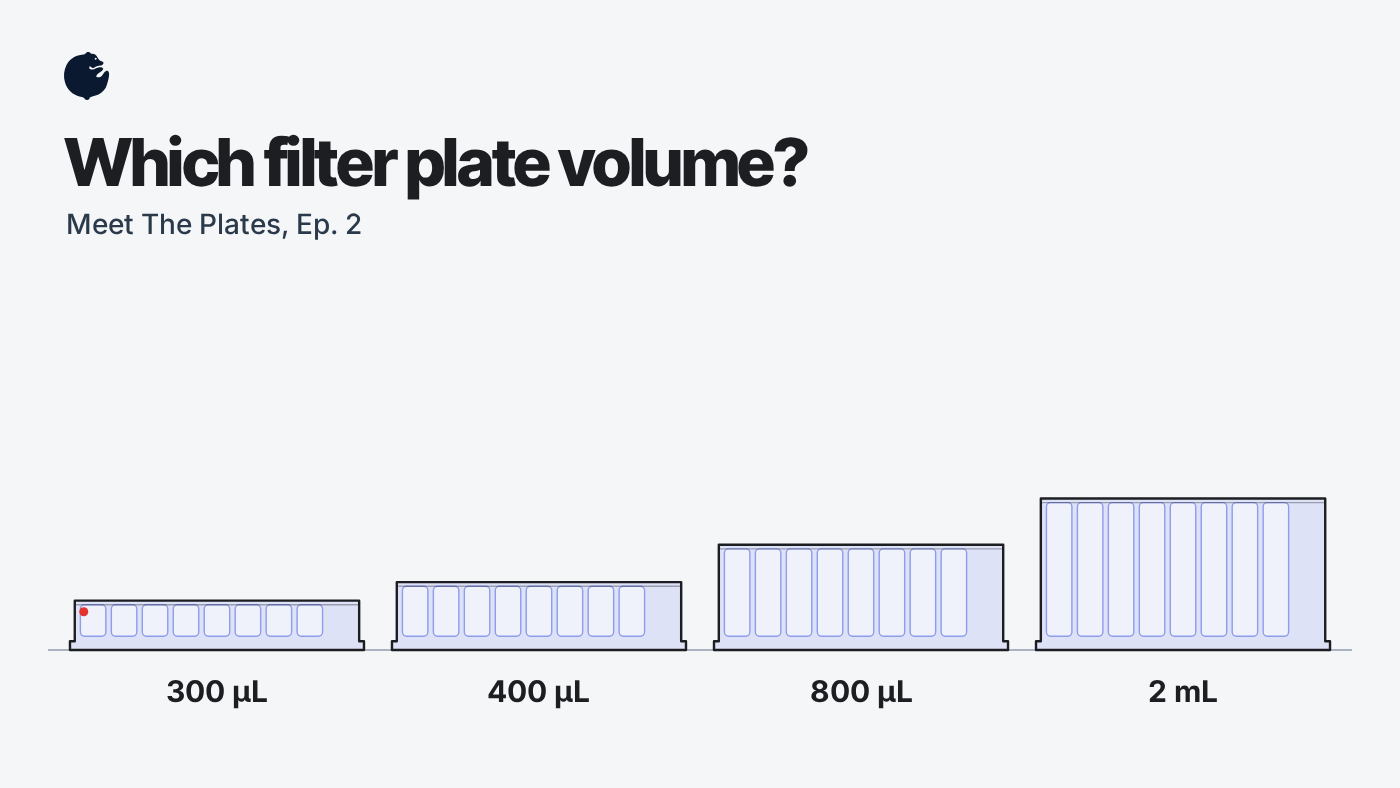
The short answer: pick the smallest volume that holds your sample
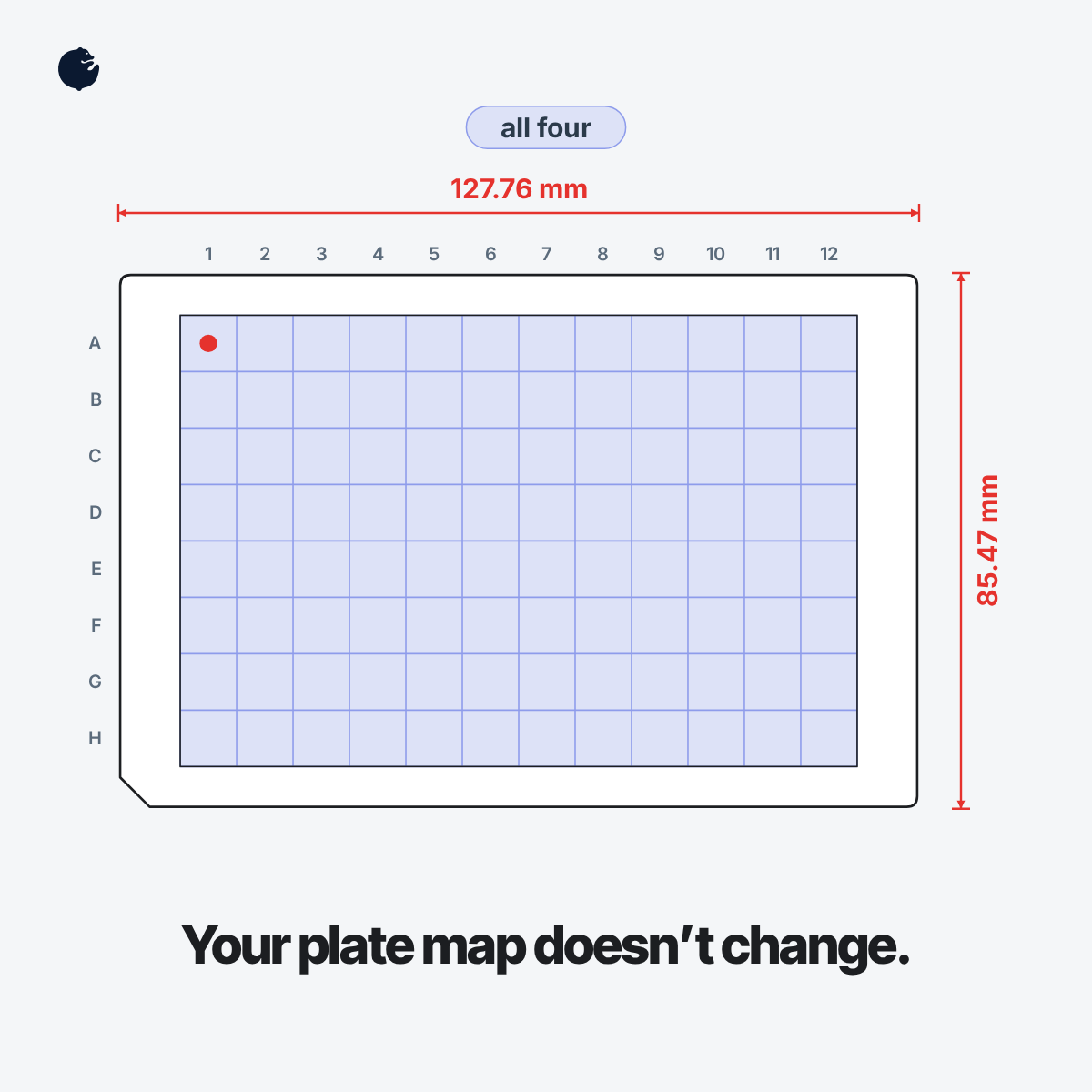
Our four 0.45 µm polypropylene (PP) 96 well filter plates share the same ANSI/SLAS (SBS) footprint, 127.76 x 85.47 mm, and the same membrane. The thing you are choosing is nominal well volume: 300 µL, 400 µL, 800 µL or 2 mL.
So start with your sample volume per well, and pick the smallest plate that holds it in one load. If no plate holds it in one load, decide whether you would rather run more loads on a smaller plate or one load on the 2 mL plate.
Watch it in 41 seconds
The four plates side by side
From the product pages, checked 2026-10-25:
| SKU | Nominal volume | Well shape | Case quantity |
|---|---|---|---|
| AWFP-F20039 | 300 µL | Round | 50 |
| AWFP-F20012 | 400 µL | Round | 25 |
| AWFP-F20005 | 800 µL | Round | 25 |
| AWFP-F20061 | 2 mL (2000 µL) | Square | 25 |
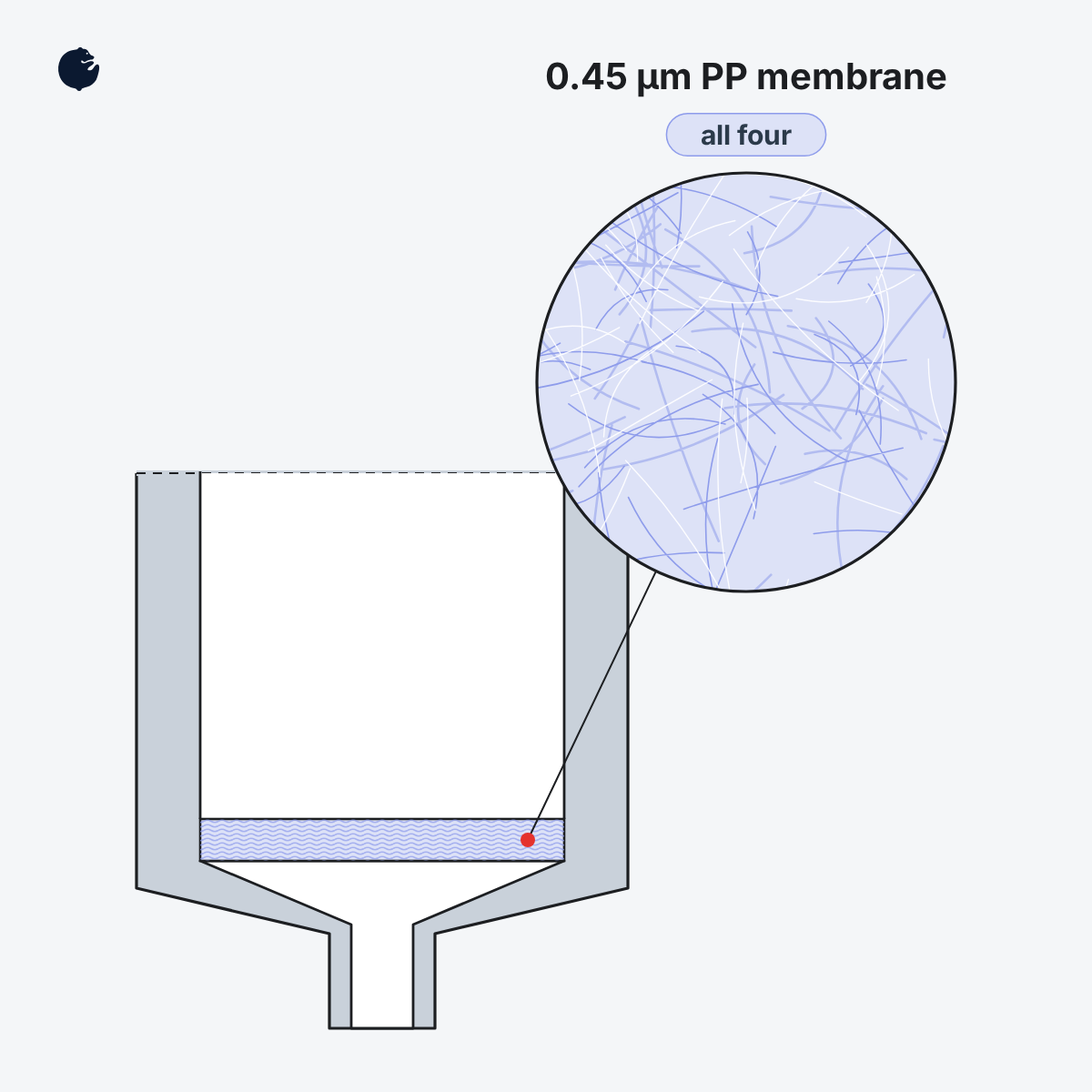
All four: 96 wells, polypropylene (PP) membrane, 0.45 µm pore size, Hydrophilic: No, long drip director, ANSI/SLAS (SBS) footprint (127.76 x 85.47 mm). Browse all PP filter plates.
Same footprint, same membrane: what stays the same
Every one of the four plates lists the same ANSI/SLAS (SBS) footprint, 127.76 x 85.47 mm, and 96 wells. Your plate map does not change when you move between volumes.
The membrane is also the same on all four: polypropylene (PP), 0.45 µm pore size, listed as not hydrophilic. All four list a long drip director. Switching volume does not switch membrane.
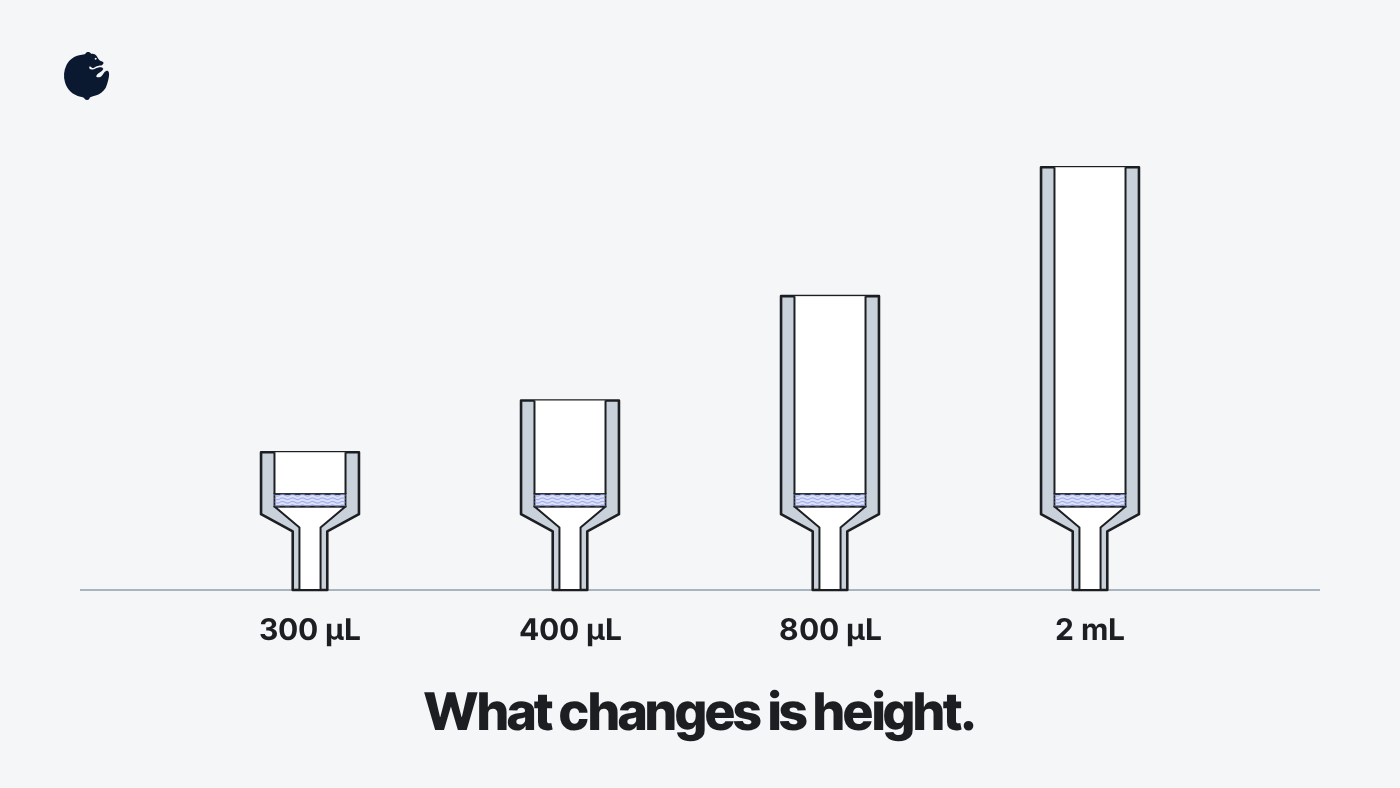
What changes: volume and height
The 2 mL plate holds 2000 / 300 = 6.67 times the nominal volume of the 300 µL plate, or nearly seven times. Each step up in volume is also a taller plate, so the 2 mL plate is the tallest of the four.
Volume grows faster than height because the wells also change. The 300 µL, 400 µL and 800 µL plates have round wells, and the 2 mL plate has square wells. A square well has about 27% more cross-section than a round well of the same width; the math is in Ep. 1, why square wells.
The decision rule, with worked examples
Rule: loads per well = your sample volume / the plate's nominal volume, rounded up. Pick the smallest plate that gives you one load. If none does, compare the loads.
| Sample per well | Plate | Math | Loads |
|---|---|---|---|
| 250 µL | 300 µL (AWFP-F20039) | 250 / 300 = 0.83 | 1 |
| 350 µL | 400 µL (AWFP-F20012) | 350 / 400 = 0.88 | 1 |
| 600 µL | 800 µL (AWFP-F20005) | 600 / 800 = 0.75 | 1 |
| 1 mL | 800 µL (AWFP-F20005) | 1000 / 800 = 1.25 | 2 |
| 1 mL | 2 mL (AWFP-F20061) | 1000 / 2000 = 0.50 | 1 |
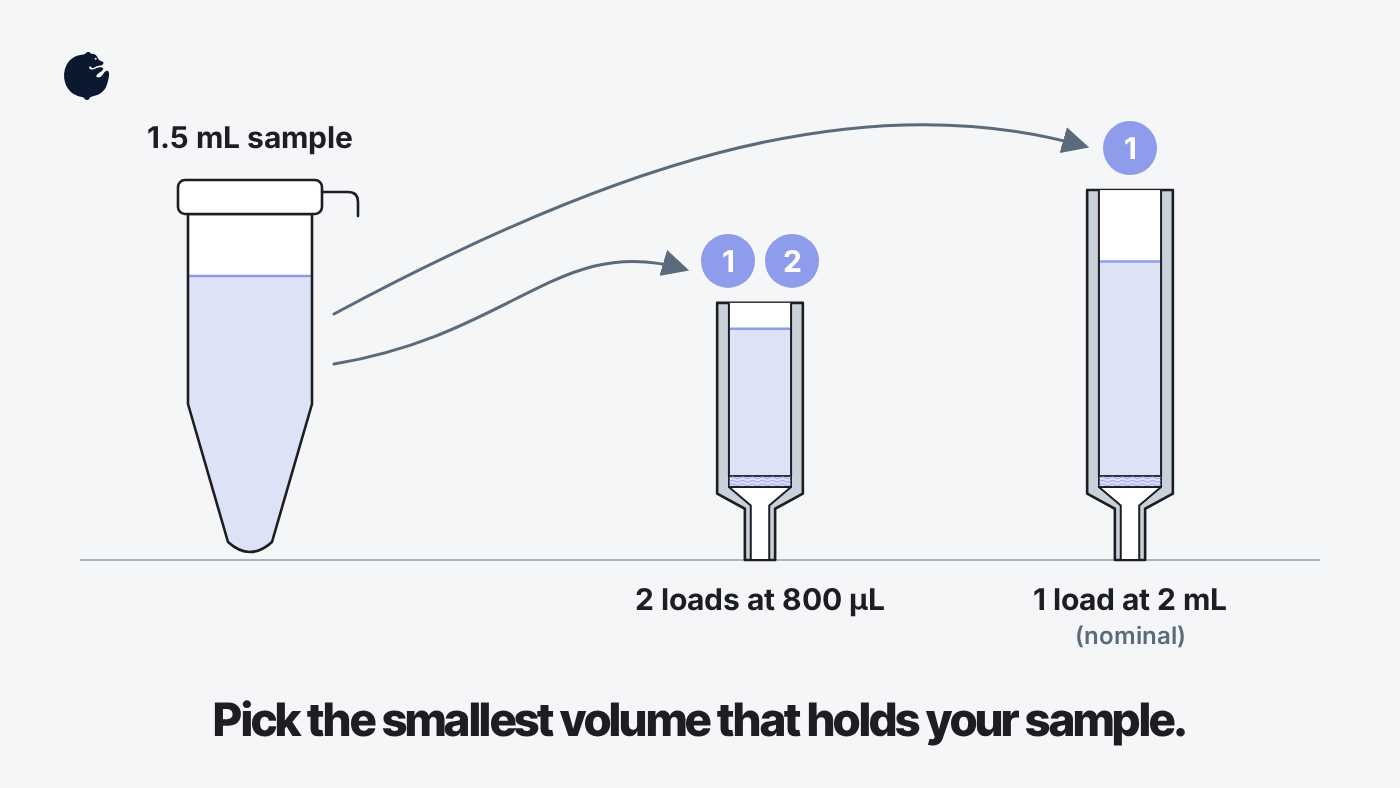
| 1.5 mL | 800 µL (AWFP-F20005) | 1500 / 800 = 1.88 | 2 |
| 1.5 mL | 2 mL (AWFP-F20061) | 1500 / 2000 = 0.75 | 1 |
A 1.5 mL sample is two loads on the 800 µL plate or one load on the 2 mL plate.
One caution: these are nominal volumes, the volume each plate is listed at. They are not a working volume rating. Check the working volume for your own method before you load a well close to its nominal volume.
FAQ
Do all four filter plates have the same footprint?
Yes. All four product pages list the ANSI/SLAS (SBS) footprint, 127.76 x 85.47 mm, with 96 wells.
Is the membrane different on the 2 mL plate?
No. All four list a polypropylene (PP) membrane with a 0.45 µm pore size, Hydrophilic: No.
Can I fill a well to its full nominal volume?
The volumes on these pages are nominal. We do not publish a working volume rating, so check the working volume for your method, and leave room if you are close to nominal.
What drip director do they have?
All four product pages list a long drip director.
About Meet The Plates
Meet The Plates is a short series from Arctic White on lab plate geometry. Each episode takes one plate decision and works through it with the specifications on the product page. Ep. 1 covered why 96 deep well plates use square wells.
Sources and math
Sources: the AWFP-F20039, AWFP-F20012, AWFP-F20005 and AWFP-F20061 product pages on arcticsci.com, checked 2026-10-25. The math is our own working.
- Volume ratio: 2000 / 300 = 6.67.
- Loads: sample / nominal volume, rounded up. 1500 / 800 = 1.875, so 2 loads; 1500 / 2000 = 0.75, so 1 load. Based on nominal volume only.
- Square vs round: 4 / pi = 1.27, about 27% more cross-section at the same width (Ep. 1).