96 and 384 well formats
Glass Coated Plates
Hydrophobic compounds don't just sit in your plate. They stick to it.
So the concentration you pipetted isn't the one you're measuring.
The fix isn't a better plastic. It's a glass surface.
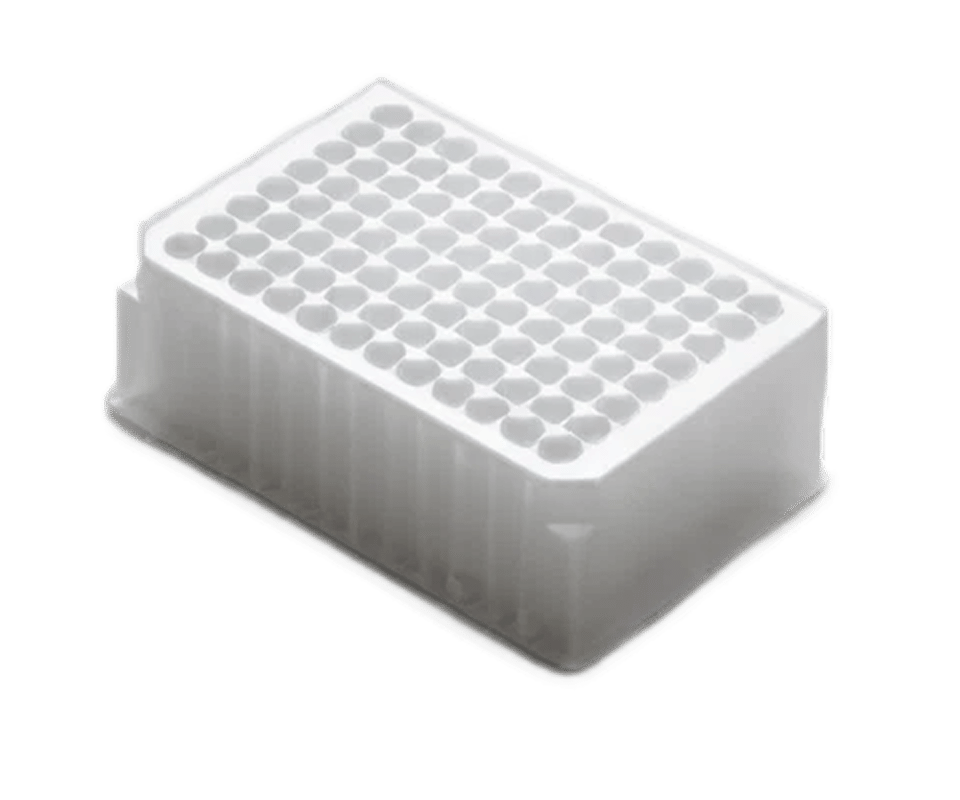
How glass coated plates work
Arctic White glass coated plates line every well with a thin layer of silicon dioxide. That's glass.
Lipophilic compounds touch glass, not plastic, so they stay in solution instead of partitioning to the plate surface. The plate keeps its plastic body and a standard SBS footprint, so it fits the readers, handlers and storage you already use.
You get the contact surface of a glass vial insert, with nothing to break.
On our 96 deep well and half-height plates the coating is specified at 200 nm, with a working range of -80 °C to +80 °C, low extractables and leachables, and a reduced oxygen transmission rate.
SiO₂
Silicon dioxide lines every well
200 nm
Coating on our 96 deep well and half-height plates
-80 to +80 °C
Working range on those same plates
SBS
Standard footprint, plastic body
Bleasby et al., 2019
Glass coated plates in peer-reviewed research
In “In Vitro Evaluation of the Drug Interaction Potential of Doravirine” (Bleasby et al., 2019), researchers studied whether the drug is taken up by the liver transporters OATP1B1 and OATP1B3. For the uptake experiments, the methods state that transfected HEK293 cells:
“were then suspended in 96-well glass-coated plates (Arctic White LLC).”
Bleasby K, Fillgrove KL, Houle R, Lu B, Palamanda J, Newton DJ, Lin M, Chan GH, Sanchez RI. In Vitro Evaluation of the Drug Interaction Potential of Doravirine. Antimicrob Agents Chemother. 2019;63(4):e02492-18.
Formats
Looking for a glass coated 96 well plate, a glass coated deep well plate, or other plates for hydrophobic compounds? Compare formats below.
| Plate | Wells | Well shape | Bottom | Volume | Height | Case |
|---|---|---|---|---|---|---|
 AWLS-219208 | 96 wells | Square | Pyramid bottom | 1 mL | Deep well | Case of 50 |
 AWLS-219209 | 96 wells | Square | Pyramid bottom | 2.2 mL | Deep well | Case of 50 |
 AWLS-S30209 | 96 wells | Square | Pyramid bottom | 2 mL | Deep well | Case of 25 |
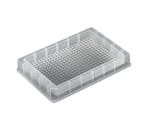 AWLS-S30226 | 96 wells | Square | Pyramid bottom | 1.1 mL | Short | Case of 25 |
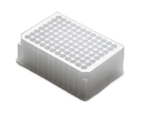 AWLS-219220 | 96 wells | Round | Conical bottom | 2.0 mL | Deep well | Case of 50 |
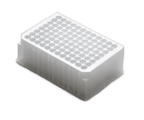 AWLS-X10205 | 96 wells | Round | Round bottom | 1.6 mL | Deep well | Case of 50 |
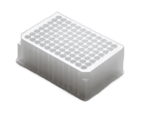 AWLS-X10204 | 96 wells | Round | Round bottom | 1.1 mL | Short | Case of 50 |
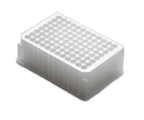 AWLS-X10203 | 96 wells | Round | Conical bottom | 500 µL | Half height | Case of 50 |
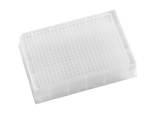 AWLS-219240 | 384 wells | Square | Pyramid bottom | 300 µL | Deep well | Case of 48 |
 AWLS-X11207 | 384 wells | Square | Flat bottom | 120 µL | Standard | Case of 10 |
Coating thickness (200 nm) and the -80 °C to +80 °C rating apply to AWLS-219208, 219209, 219220, X10203 and X10205. See each product page for its own specifications.
Where labs use them
- Storing and handling hydrophobic and lipophilic compounds
- Compound management and compound storage
- DMPK, ADME and bioanalysis work where bare plastic is not suitable
- In vitro drug interaction studies, including transporter uptake assays like those in Bleasby et al. 2019
- Replacing glass vial inserts in a plastic plate
Not sure whether your compound sticks to plastic? Try the free Compound Sticking Checker.
Need a different plate?
We'll glass-coat yours. Tell us the plate you use and we'll quote a glass coated version.
Ask about custom coatingFAQ
What is the coating made of?
Silicon dioxide (glass), applied to every well of a plastic base plate. On our 96 deep well and half-height plates the coating is 200 nm thick.
What temperatures can the plates take?
Our 96 deep well and half-height glass coated plates are rated from -80 °C to +80 °C. Check each product page for the rating of other formats.
Why not just use glass vial inserts?
The coating gives each well a glass contact surface, so you don't need limited-volume glass inserts in a plastic plate, and there is no glass to break.
Have glass coated plates been used in published research?
Yes. Bleasby et al. (Antimicrobial Agents and Chemotherapy, 2019) used our 96-well glass coated plates for OATP1B1 and OATP1B3 uptake experiments in a study of doravirine's drug interaction potential.
Can you coat a plate that isn't listed?
Yes. Send us the plate you use and we'll quote a glass coated version.