Why Square Wells? The Geometry of a 96 Deep Well Plate
By Arctic White Team. Part of Meet The Plates, Ep. 1.
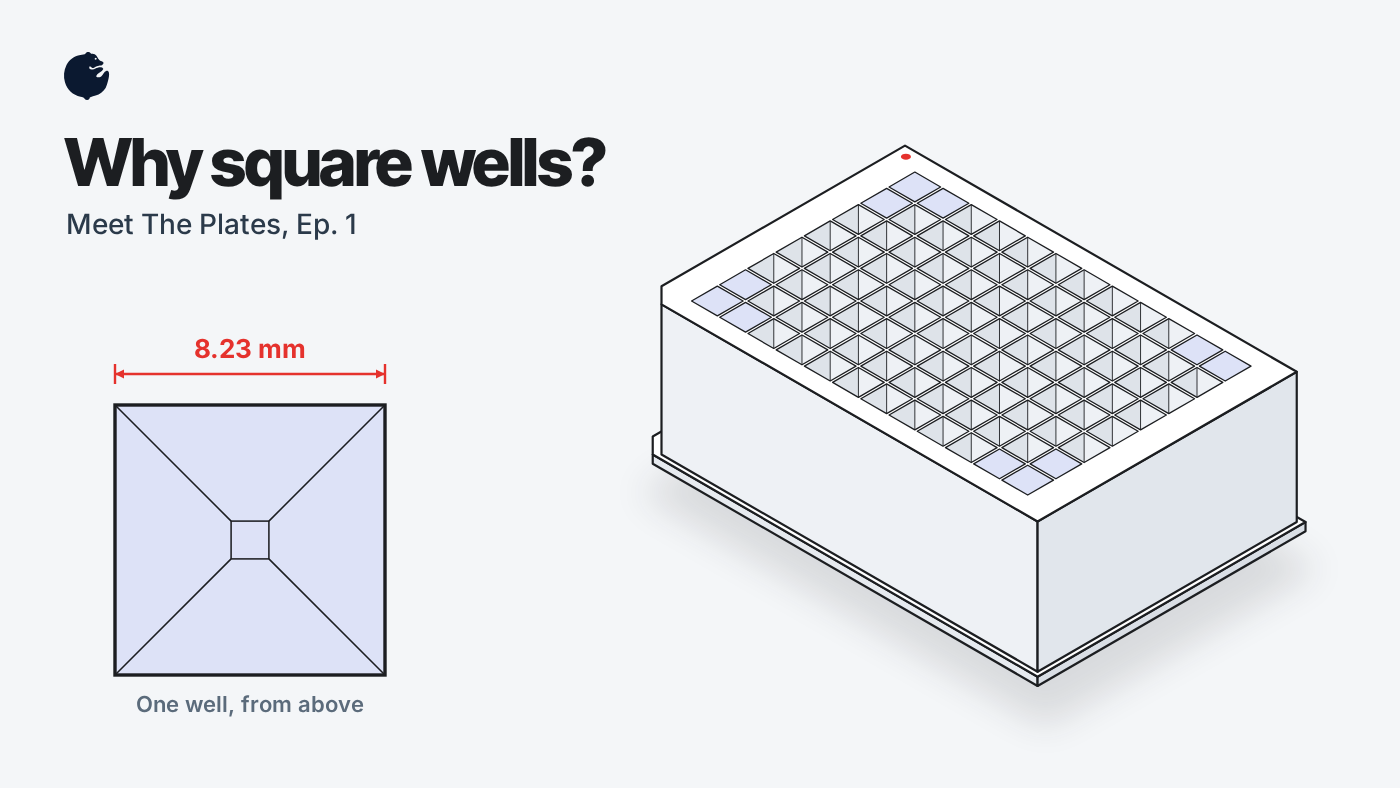
The short answer: square wells vs round wells
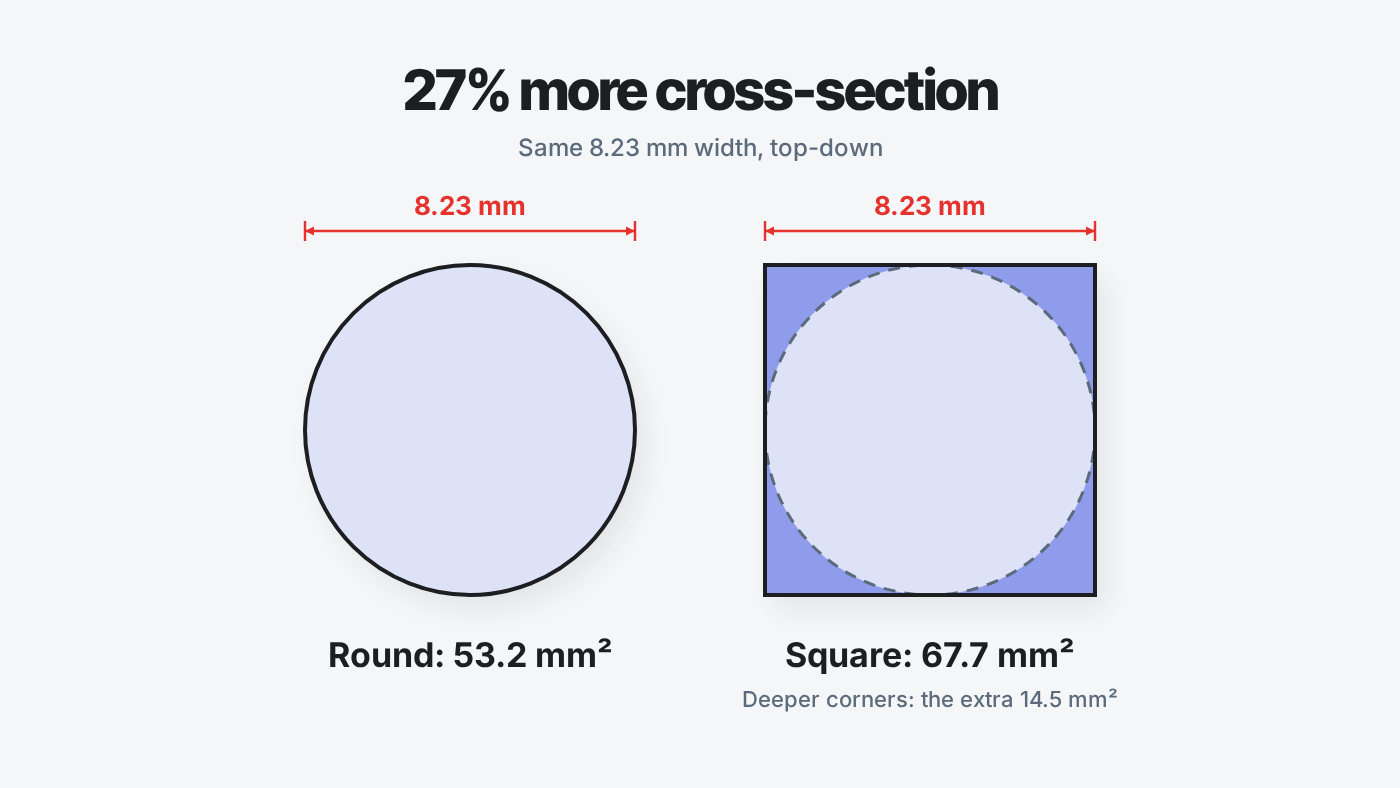
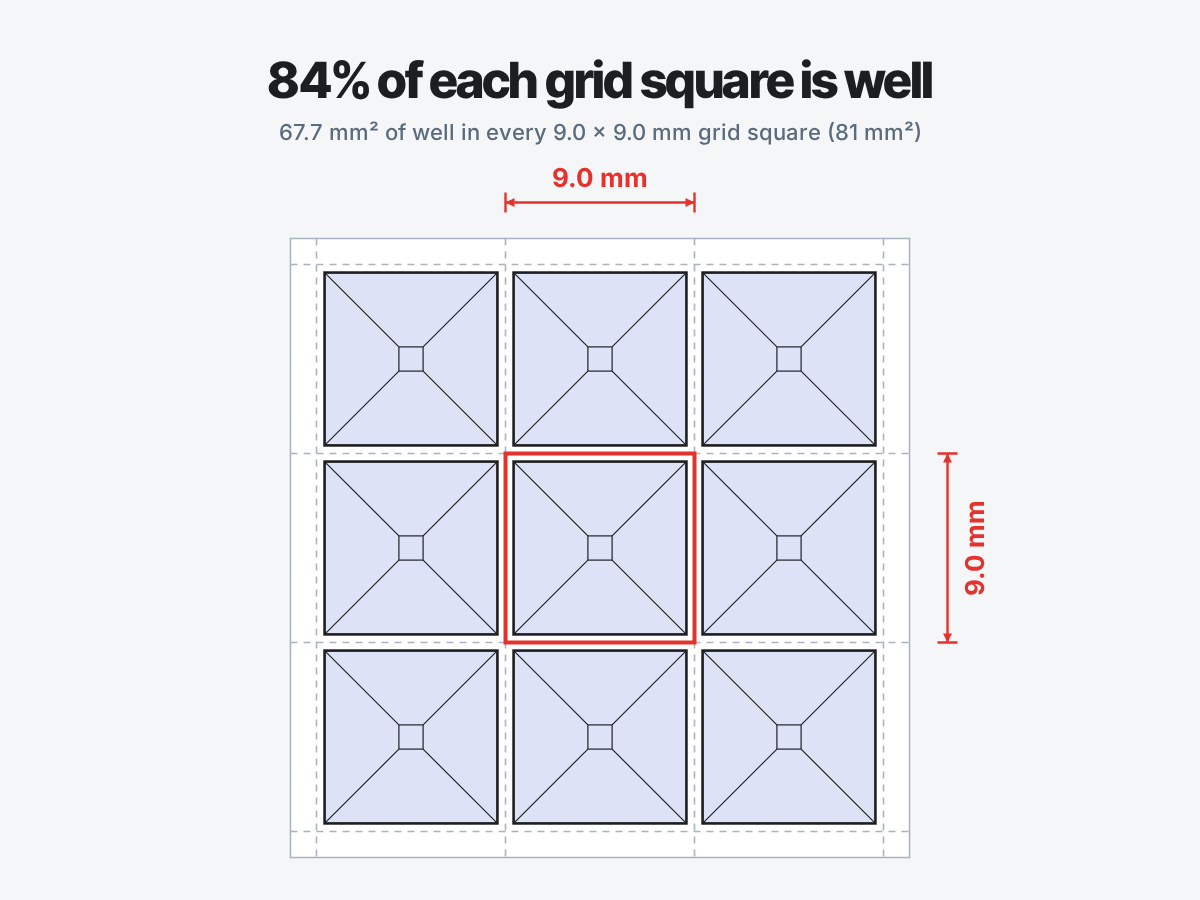
A square well uses the corners that a round well leaves as plastic. Take a square well and a round well of the same width: the square one has about 27% more cross-section. That holds at any well width, because it comes from the shapes, not the size.
This guide walks through the geometry of our 96 square deep well plate (AWLS-S30009): 96 square wells, 2 mL nominal per well, Pyramid bottom. The working is shown so you can check every step.
AWLS-S30009 at a glance (from the product page, checked 2026-10-25):
| Spec | AWLS-S30009 |
|---|---|
| Wells | 96 |
| Well shape | Square |
| Bottom | Pyramid |
| Volume | 2 mL nominal |
| Material | Polypropylene (PP) |
| Format | ANSI/SLAS (SBS) standard footprint |
| Temperature range | -86 °C to ambient |
| Sterility | Non-sterile |
| Case quantity | 25 |
Square vs round well area math
Take two wells with the same width w, one square and one round.
- Square: w x w = w²
- Round, diameter w: pi x (w / 2)² = (pi / 4) x w², about 0.785 x w²
- Ratio: w² / (0.785 x w²) = 4 / pi = 1.27
So the square well has about 27% more cross-section. The width stays the same. The extra area comes only from the four corners.
Fill height rule for a square deep well
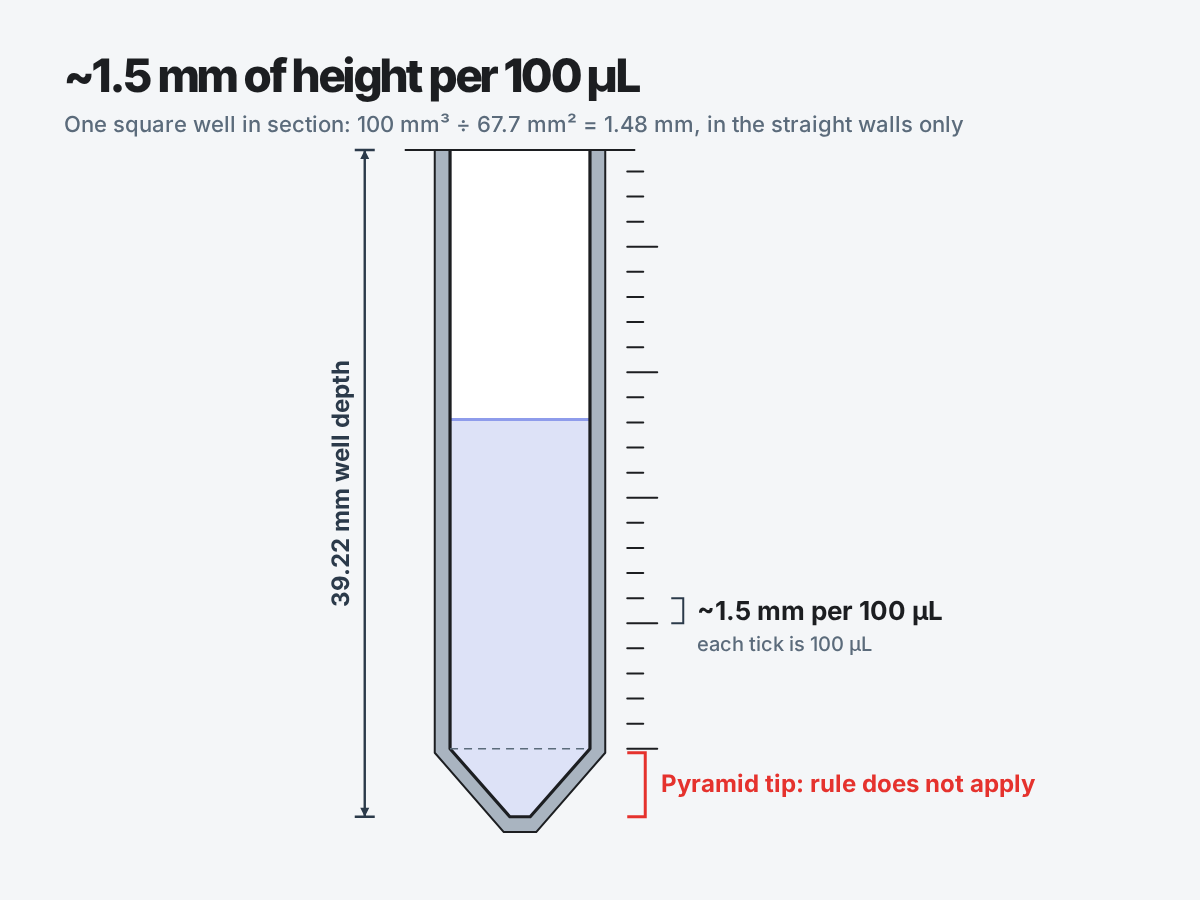
Because 1 µL is 1 mm³, you can turn volume into liquid height by dividing by the cross-section.
- Rise in level (mm) = volume added (µL) / cross-section (mm²)
With about 27% more cross-section, the same volume raises the level in a square well to about 0.785 of the rise in a round well of the same width, or about 21% less. In the straight section of the well, every equal step of volume raises the level by an equal step.
Two caveats. First, this is an approximation that assumes straight walls. Second, it does not apply in the Pyramid tip. The well narrows toward the bottom, so the same volume gives a different height there. Use the rule for changes in level above the tip, not for the height measured from the very bottom of the well.
How to use the fill height rule
Measure the well opening of your plate, square it to get the cross-section in mm², and divide the volume you add by that number. Run it backward to find the volume for a given rise: multiply the rise in mm by the cross-section.
This is handy when you set a pipetting height in a method or mark a fill line on a plate map. Treat it as an estimate and check it against a real plate for anything critical.
Pyramid bottom: why the rule stops at the tip
Each well has a Pyramid bottom, so the cross-section narrows toward the bottom. That is why the fill height rule above stops at the tip: down there, the same volume no longer gives the same rise.
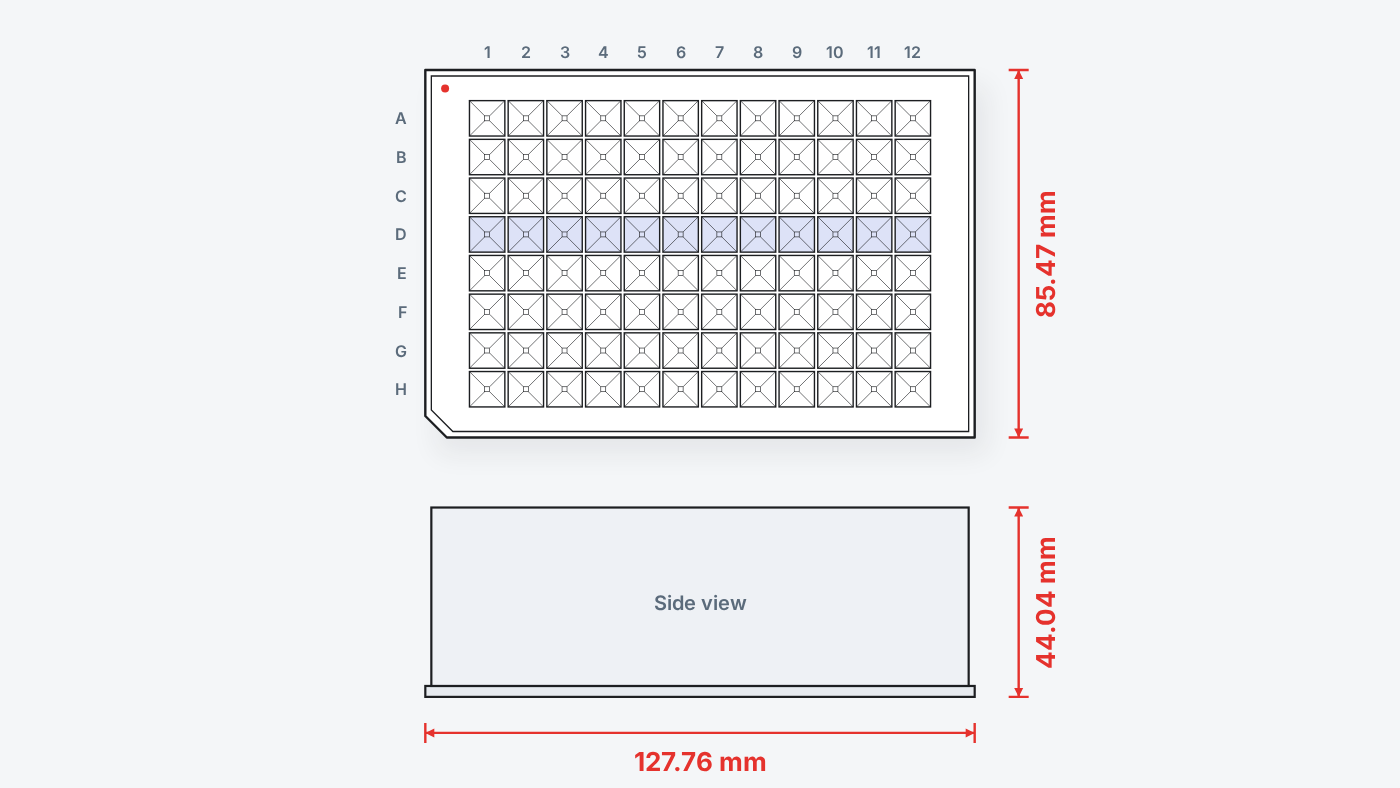
96 well format and ANSI/SLAS (SBS) footprint
The plate has 96 square wells on an ANSI/SLAS (SBS) standard footprint. Browse all 2 mL 96 deep well plates, or use the Microplate Guide if you are still choosing a plate type. For help choosing a seal, see the Sealing Guide.
Glass coated version: AWLS-S30209
There is also a glass coated version (AWLS-S30209). AWLS-S30209 is the glass coated version, 25 plates per case.
About Meet The Plates
Meet The Plates is a short series from Arctic White on lab plate geometry. Each episode takes one plate decision and works through it with the specifications on the product page.
See the AWLS-S30009 specifications, 96 square deep well plate, 2 mL nominal.
Sources and math
Source: AWLS-S30009 product page on arcticsci.com, checked 2026-10-25. The math is our own working from standard geometry.
- Square area: w². Round area: pi x (w / 2)² = 0.785 x w².
- Ratio: 4 / pi = 1.273, about 27% more.
- Fill height: 1 µL = 1 mm³, so rise = volume / cross-section. Same volume in the square well: pi / 4 = 0.785 of the round well's rise, about 21% less. Straight walls assumed; not valid in the Pyramid tip.