Reservoirs
Reagent reservoirs for multichannel pipettes and liquid handlers. Filter by layout, bottom and coating.
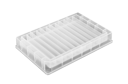
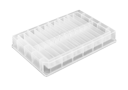
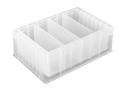
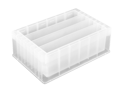
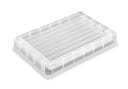
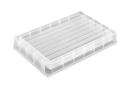
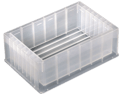
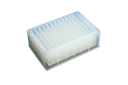
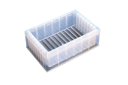
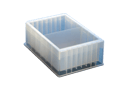


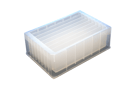
Specifications across the family
- Formats: Single cavity (96 pyramid base or 384), partitioned by columns (8, 12 and 24 channels), low profile versions of both
- Volumes: 92 mL (low profile 384) to 287 mL (96 well); a 384 well standard reservoir holds 282 mL
- Footprint: ANSI/SLAS (SBS), 127.76 x 85.47 mm
- Height: 19.05 mm low profile to 44.04 mm full height
- Bottom: Pyramid, which gathers reagent under the tip positions and cuts dead volume; flat bottom also listed
- Material: Polypropylene; a glass coated version (AWLS-S32014) for compounds that stick to plastic
- Options: Black, sterile irradiated partitioned reservoirs, disposable trays
Start with these reservoirs
- AWLS-S30014, the standard 96 well reservoir: 287 mL, pyramid bottom, $242 per case of 25.
- AWLS-S30021, the 384 well version at 282 mL, $339 per case of 25.
- AWLS-S30022, low profile 384 at 92 mL and 19.05 mm tall, for handler decks where stack height matters.
- AWLS-S30028, 12 column partitioned, $207 per case of 25: one reagent per column for a 12 channel pipette.
- AWLS-S32014, glass coated 96 well, for compound work where plastic adsorption is the problem.
- AWLS-219010, the disposable single cavity tray (also through Fisher Scientific, Cat. No. 50-013-41098).
Questions
What is a partitioned reservoir for?
Walls divide the reservoir into channels, one per pipette channel, so each channel draws a different reagent from the same footprint. The 8, 12 and 24 column versions match the pipette.
Why do reservoirs have pyramid bottoms?
The pyramids gather the last of the reagent under the tip positions instead of spreading it across a flat floor, so more of what you poured is reachable. That dead volume difference decides how much expensive reagent a run wastes.
When is low profile the right choice?
When deck or stack height is the limit. The low profile 384 holds 92 mL at 19.05 mm tall, against 282 mL at full height. Choose by the volume the run actually draws.
Is there a reservoir for compounds that stick to plastic?
Yes. AWLS-S32014 is the glass coated version of the standard 96 well reservoir. The reasoning is the same as for glass coated plates, covered in Glass Coated Plates: When Compounds Stick to Plastic.